Do Challenges to Viability Make the Unborn Less Human?
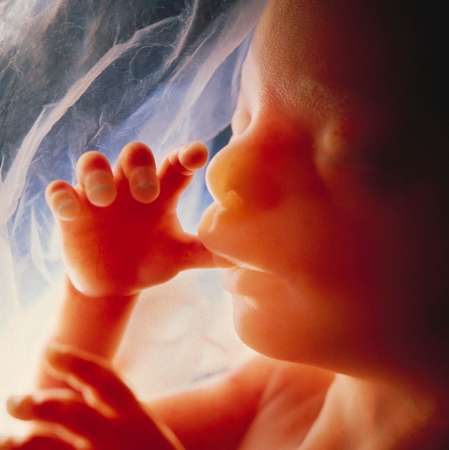 I have recently been reading Life Before Birth: The Challenges of Fetal Development by Peter W. Nathanielsz, M.D., PhD. This book is a fascinating narrative and textbook on fetal development. It is well written and provides a factual account of the development of the unborn.
I made it to the end of the second chapter and was presented with a very thought provoking conclusion to that chapter:
The knowledge, for instance, that when the egg meets the sperm the resulting cell contains all the genetic information necessary to set in motion a process that will result in a unique human being, is knowledge that challenges many traditional philosophies, religions, and folklore. We shall see that the expression of this unique capability of the egg and sperm is dependent on environmental conditions within the uterus and interactions with the maternal organism. Thus, some may consider that the individual capacities of the sperm and unfertilized egg constitute life just as much as the fertilized egg. We know that the fertilized egg has many developmental hurtles to jump before it becomes a viable fetus.
The intellectual and philosophical repercussions of this knowledge have still to be properly absorbed and digested. Our moral philosophy has yet to evolve a system of thought that fully accepts man's physical being as being a product of a relentless and predictable process of cell growth and differentiation.
The last paragraph is very telling. The author's states that our philosophy has not evolved enough to handle this new knowledge. It seems as though he is convinced that from the earliest stages of life (fertilization) the unborn are fully human. He masks the implications of this knowledge with the viability argument.
The viability argument is not viable for on simple reason. Viability arguments can be made against the infirm, sick and terminally ill that we have among our society. Does it follow that because these lives are not viable in the long term that they are any less human today? The author says:
We know that the fertilized egg has many developmental hurtles to jump before it becomes a viable fetus.
I have many viability hurtles to jump as well. Does that make me less than human? Less than two weeks ago, I wrecked a motorcycle and it was only by God's grace and providence that I was not injured or killed. Is it not the same with the fertilized embryo from the earliest stages of development? They also will faces threats to further growth and development of life but these challenges do not take away from their status as full members of the human family.
The viability argument is merely a variation of the degree of dependency argument. Scott Klusendorf has addressed that many times over and Abort73 has addressed the degree of dependency argument as well.
The author may be conflicted by the "repercussions of this knowledge" and he leads off the next chapter with Psalm 139:13-14
For thou hast possessed my reins: thou hast covered me in my mother's womb. I will praise thee; for I am fearfully and wonderfully made: marvellous are thy works; and that my soul knoweth right well. (KJV)
After considering all of this, I sent a letter via e-mail to Dr. Nathanielsz, author of Life Before Birth. The purpose of this letter was to question some confusing statements that were made at the end of 2nd chapter of his book. I attempted to frame my questions well and was disappointed when I did not receive a response.
Due to this lack of response, I have chosen to publish this letter publicly in hopes that someone may attempt to answer the questions I raised that Dr. Nathanielsz is unable, unwilling or too scared to answer.
Dr. Nathanielsz,
I have started reading your text, Life Before Birth: The Challenges of Fetal Development. I have enjoyed the reading so far. It is well written and very accessible to someone without formal training in a biology field.
I had a question for you related to the last two paragraphs in Chapter 2 of this book. They read as follows:
"The knowledge, for instance, that when the egg meets the sperm the resulting cell contains all the genetic information necessary to set in motion a process that will result in a unique human being, is knowledge that challenges many traditional philosophies, religions, and folklore. We shall see that the expression of this unique capability of the egg and sperm is dependent on environmental conditions within the uterus and interactions with the maternal organism. Thus, some may consider that the individual capacities of the sperm and unfertilized egg constitute life just as much as the fertilized egg. We know that the fertilized egg has many developmental hurtles to jump before it becomes a viable fetus.
The intellectual and philosophical repercussions of this knowledge have still to be properly absorbed and digested. Our moral philosophy has yet to evolve a system of thought that fully accepts man's physical being as being a product of a relentless and predictable process of cell growth and differentiation."
You stated that the repercussions of this knowledge have yet to be properly absorbed and digested. What did you mean by this statement? In what ways do you believe our society and our world have yet to digest this knowledge? What conclusions do believe we should rightly come to when this knowledge that from the earliest stages of embryo development (fertilization) the fetus is distinctly human is digested?
The second question I had with this section of your book was with your statement about the fertilized egg having developmental hurdles to overcome before it becomes a "viable fetus." When does this distinction between "fertilized egg with developmental hurdles" and "viable fetus" occur? Do these "developmental hurdles" make the "fertilized egg" any less human than the "viable fetus"?
Thank you for considering these questions. Is there an account of your father's work that you refer to in your dedication? I would be interested in learning more about the Ceylon Crippled Children's Association.
Thank you,
Brian
Cross-blogged at Worldview Warrior