That Old Tattered Flag
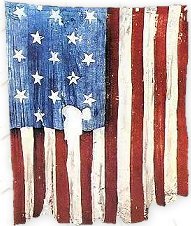 Recently I had the opportunity to visit a few of the Smithsonian Museums in Washington D.C. My favorite one was the Museum of American history. As soon as I walked through the doors of the huge museum, I felt a renewed sense of awe and appreciation for our country. The main doors opened into a large room where an enormous flag hung suspended from the ceiling. The flag looked rather dirty, though, and it even had a large black streak across part of it. Wanting to see why it was smudged, I walked closer and noticed a descriptive label located just underneath it. I began to read the label and soon learned that this very flag had been unfurled on the nation’s pentagon on September 12, 2001, the day after terrorists hijacked planes and flew them into the World Trade Center and the Pentagon.
The label under the flag helped me understand that when people hung that flag on the pentagon the day after the terrorist attacks, it served as a symbol of unity and a reminder to the world that Americans still stood together for freedom. But as I looked at the giant flag, and so easily recalled the emotions I went through on September 11, 2001, I realized that I would never be able to fully explain those emotions to my children or grandchildren. And although I wouldn’t want them to ever have to feel all of what I felt on that day, I do want them to understand a part of it. I want future generations to feel the pride I have in the many heroes who risked their own lives to save the lives of others as flames engulfed the Twin Towers and they began to collapse. I want them to have some comprehension of the gratitude I have for the passengers on flight 193 who thwarted the plans of the hijackers who attempted to destroy part of the capital city. I want them to share in my deep appreciation for the civilians and servicemen and women who were working in the pentagon on 9/11.
As I stood there staring at the flag and remembering the events of that day in our history, I began to more fully appreciate the importance of preserving our history. Now, as I reflect on what I saw today in the museums, I remember the words of a friend of mine who once stated that our knowledge of history helps determine the way we view both our present and our future. My friend’s words now make more sense to me. I would probably look at the world a lot differently if I didn’t know what happened on September 11th. If it weren’t for my knowledge of those events, I would probably view the world as a much safer place. I can imagine that I would still see my hometown in Georgia as protected and immune from human-led destruction. It would never cross my mind that someone from across the world could step onto a place, make one sudden move and disrupt my feelings of stability and security.
Now I continue to turn the words of my friends over and over in my head. Yes, our knowledge of history definitely affects our views of the present. I think it would be fair to take that statement one step further and assert that our knowledge of the past affects not only our views of the present, but also the decisions that we make. If it hadn’t been for the terrorist attacks of 9/11, I would probably make different decisions regarding my own security. I probably would not think twice about stepping on a plane and I definitely would have different ideas about political measures regarding national security.
In a society such as the one in which we live here in the United States, our knowledge of history can have an even greater impact on our culture, because here, each citizen of legal age has the ability to participate in the legislative process. People are allowed to vote their conscience and therefore influence the way our society operates. If our views of history affect our daily decisions, they must also have significant impact on the way we vote, and therefore on the way our society operates. This realization hit me especially hard when I began to see how it played into my Christian walk.
As Christians, we have even more of a responsibility to learn about and preserve our past because we know the importance of giving God the central role in our country. Our nation has a rich heritage rooted in Judeo-Christian values. Our founding fathers believed that if our country was to survive, it would only do so with God’s help. That is why Benjamin Franklin suggested that Congress should pray at the beginning of every legislative session. Sadly, many people have forgotten about God’s role in our history. That is why we must, as Christians unite together to first learn more about our heritage and then help others understand it. After all, if our knowledge of history really does affect the decisions we make every day, then America could be a different place if we knew a little more about where we come from and the values that first united our society.