Not Another Gospel - Part Three
In the final post in this three part series, I would like to focus on the story of Jesus and the woman of Samaria at the well found in John 4. Previously, I wrote about the Gospel as Jesus presented it to Zacchaeus, a rich tax collector and Nicodemus, a learned Pharisee. Now we see Jesus encountering a woman from Samaria and breaking custom of the Jews to not associate with the Samarians.
As Jesus was leaving Judea headed for Galilee, he had to pass through Samaria. He stopped at a well, Jacob's well, and a woman of Samaria came to draw water. Jesus said to her, "Give me a drink."
The Samaritan woman said to him, "How is it that you, a Jew, ask for a drink from me, a woman of Samaria?" (For Jews have no dealings with Samaritans.) Jesus answered her, "If you knew the gift of God, and who it is that is saying to you, 'Give me a drink,' you would have asked him, and he would have given you living water." The woman said to him, "Sir, you have nothing to draw water with, and the well is deep. Where do you get that living water? Are you greater than our father Jacob? He gave us the well and drank from it himself, as did his sons and his livestock." Jesus said to her, "Everyone who drinks of this water will be thirsty again, but whoever drinks of the water that I will give him will never be thirsty forever. The water that I will give him will become in him a spring of water welling up to eternal life." The woman said to him, "Sir, give me this water, so that I will not be thirsty or have to come here to draw water."
Here we see Jesus speaking of the Gospel using a word picture. He uses a picture of living water. Water that will make you never thirst again. How often to we speak of the gospel using a four point bullet outline that fits well in a powerpoint presentation? Jesus chose a different approach (not to mention he didn't have PowerPoint in his day). Jesus used a word picture, living water, a spring of water welling up to eternal life.
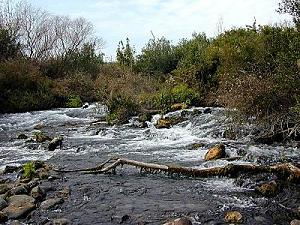 As if it was yesterday, I remember visiting Israel in 1999 and seeing the head waters of the Jordan river at Tel-Dan. This is the largest of four sources of the Jordan River. It is a spring at the base of Mt. Hermon. Now this spring was gushing with cold water in the midst of a hot summer day in northern Israel. This spring gave life to all that was around it. This was the picture Jesus was using. He was showing the Samarian woman that this spring of water that you may become would well up to eternal life.
After he had shown her what living water could do in her life, he brought conviction upon her heart. His words, perfect through his own omniscience, were convicting without speaking an accusatory word.
Jesus said to her, "Go, call your husband, and come here." The woman answered him, "I have no husband." Jesus said to her, "You are right in saying, 'I have no husband'; for you have had five husbands, and the one you now have is not your husband. What you have said is true."
The woman is left undone. Jesus has shown her that he knows her life more intimately than she herself knows it.
The woman said to him, "Sir, I perceive that you are a prophet. Our fathers worshiped on this mountain, but you say that in Jerusalem is the place where people ought to worship." Jesus said to her, "Woman, believe me, the hour is coming when neither on this mountain nor in Jerusalem will you worship the Father. You worship what you do not know; we worship what we know, for salvation is from the Jews. But the hour is coming, and is now here, when the true worshipers will worship the Father in spirit and truth, for the Father is seeking such people to worship him. God is spirit, and those who worship him must worship in spirit and truth." The woman said to him, "I know that Messiah is coming (he who is called Christ). When he comes, he will tell us all things." Jesus said to her, "I who speak to you am he."
She had been introduced to Jesus, Messiah. Her Jesus heritage, although tainted by being a Samarian, had taught her to expect Messiah. She knew the law and the prophets. Jesus the prophet had shown her the future Kingdom of God. He explained that although she felt as though she was rejected by the Jewish people for being a mixed breed and in the midst of her own broken life, there is coming a day when worshippers will no longer be required to worship and offer sacrifices in Jerusalem.
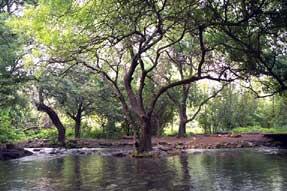 Jesus had just shown her the promise of new life, eternal life, living water, and a spring welling up giving life to all that is around it. He had also shown her the brokenness in her life and the world around her. This was the Truth speaking the truth about the world around us, broken relationships, broken societies, and broken temples. This hunger and thirsting for a living water would soon be quenched with the perfect lamb by the perfect priest.
When we present the Gospel in the midst of brokenness, we are sure to face opposition. Often this opposition comes from those closest to us and in Jesus' case it was the disciples.
Just then his disciples came back. They marveled that he was talking with a woman, but no one said, "What do you seek?" or, "Why are you talking with her?" So the woman left her water jar and went away into town and said to the people, "Come, see a man who told me all that I ever did. Can this be the Christ?" They went out of the town and were coming to him.
Meanwhile the disciples were urging him, saying, "Rabbi, eat." But he said to them, "I have food to eat that you do not know about." So the disciples said to one another, "Has anyone brought him something to eat?" Jesus said to them, "My food is to do the will of him who sent me and to accomplish his work. Do you not say, 'There are yet four months, then comes the harvest'? Look, I tell you, lift up your eyes, and see that the fields are white for harvest. Already the one who reaps is receiving wages and gathering fruit for eternal life, so that sower and reaper may rejoice together. For here the saying holds true, 'One sows and another reaps.' I sent you to reap that for which you did not labor. Others have labored, and you have entered into their labor."
Jesus uses word pictures to explain how he is feasting on the will of the Father. Jesus is attempting to get the disciples to see the Gospel. Is that a strange phrase for us in our "Americanized Christianity", seeing the Gospel? We must see the Gospel. This involves seeing the brokenness around us but also seeing the beauty around us. This gives us a glimpse of God's creation and yet shows us, through our own broken lives and the fallenness around us, the need for redemption, for living water, for harvesting what others have sown. The disciples didn't get it.
The results of Jesus allowing the Samarian woman to see the Gospel was remarkable. The woman told all of those around her. She invited them to come and see the Gospel too and they did. They saw and believed.
Many Samaritans from that town believed in him because of the woman's testimony, "He told me all that I ever did." So when the Samaritans came to him, they asked him to stay with them, and he stayed there two days. And many more believed because of his word. They said to the woman, "It is no longer because of what you said that we believe, for we have heard for ourselves, and we know that this is indeed the Savior of the world."
After the two days he departed for Galilee. (For Jesus himself had testified that a prophet has no honor in his own hometown.) So when he came to Galilee, the Galileans welcomed him, having seen all that he had done in Jerusalem at the feast. For they too had gone to the feast.
May we each allow people to see the Gospel in its fullness. Not a bulleted PowerPoint presentation of the four points to know God. Let us show people the Gospel, the hunger and thirsting in the world around us and the Living Water.